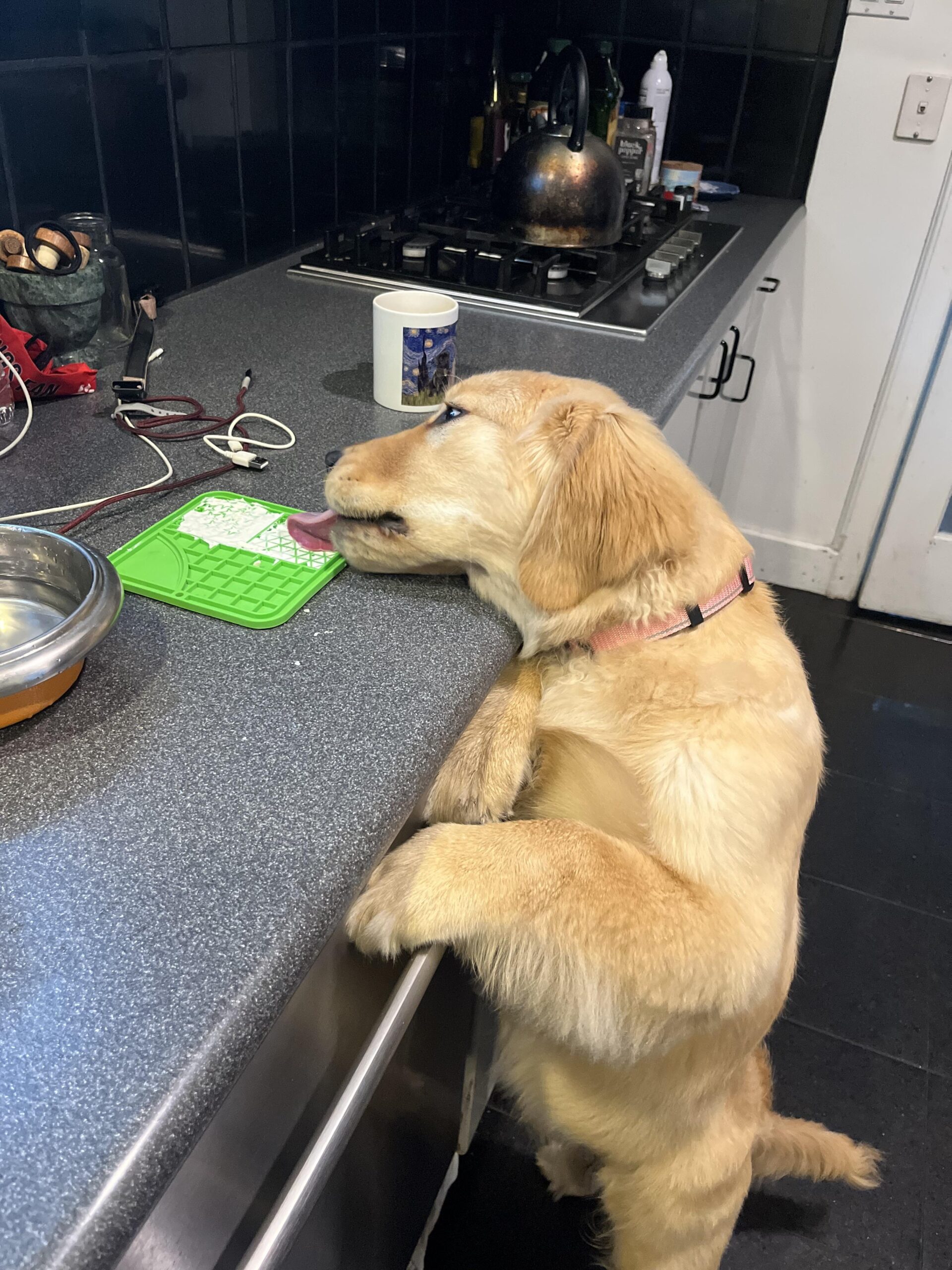
Ever walked into your kitchen only to find your dog’s paws on the counter and your dinner scattered across the floor? I’ve been there, and trust me, counter surfing is one of the most frustrating behaviors dog owners face. But here’s the good news – with the right approach, you can teach your furry friend that counters are completely off-limits.
Understanding Counter Surfing Behavior
Counter surfing happens when dogs jump up or place their front paws on kitchen counters, tables, or other elevated surfaces to snag food or investigate interesting smells. This behavior stems from your dog’s natural scavenging instincts and their incredible sense of smell – they can detect food aromas from across the room.
Key Terms to Know:
: Counter Surfing : The act of a dog jumping up onto counters, tables, or elevated surfaces to access food or items
: Positive Reinforcement : Rewarding desired behavior to increase the likelihood it will be repeated
: Environmental Management : Modifying the physical environment to prevent unwanted behaviors
: Impulse Control : A dog’s ability to resist immediate temptations and follow commands
: Food Motivation : The degree to which a dog is driven by food rewards and treats
The main reasons dogs counter surf include hunger, boredom, curiosity, and most importantly – success. Every time your dog successfully grabs something from the counter, they’re rewarded for the behavior, making it more likely to happen again.
Materials Needed
| Training Materials | Quantity | Purpose | Estimated Cost |
|---|---|---|---|
| High-value treats | 1 bag | Reward good behavior | $8-15 |
| Clicker (optional) | 1 | Mark desired behaviors | $3-5 |
| Baby gates | 1-2 | Block kitchen access | $25-50 each |
| Motion-activated deterrent | 1 | Discourage counter access | $20-40 |
| Long training leash | 1 (6-8 feet) | Supervised practice | $10-20 |
| Puzzle toys/Kong | 2-3 | Mental stimulation | $15-25 each |
| Bitter apple spray | 1 bottle | Counter deterrent | $8-12 |
| Training mat/bed | 1 | Designated “place” spot | $20-35 |
Step-by-Step Training Method
Phase 1: Foundation Training (Week 1-2)
• Teach the “Off” Command
- Start with your dog on a leash indoors
- When they approach the counter, gently guide them away
- Say “Off” in a firm but calm voice
- Reward immediately when all four paws are on the ground
- Practice 5-10 repetitions daily
• Establish a “Place” Command
- Choose a specific spot away from the kitchen (dog bed or mat)
- Guide your dog to the spot and say “Place”
- Reward when they lie down and stay
- Gradually increase duration from 10 seconds to 5 minutes
Phase 2: Kitchen-Specific Training (Week 2-4)
• Supervised Kitchen Time
- Keep your dog on a leash while cooking
- The moment they show interest in the counter, redirect with “Off”
- Immediately guide them to their “place” and reward
- Never leave food unattended during this phase
• Impulse Control Exercises
- Place a treat on the floor and cover with your hand
- Only give the treat when your dog stops pawing and sits calmly
- Progress to placing treats on low surfaces, then higher ones
- This builds self-control around tempting items
Phase 3: Advanced Training (Week 4-8)
• Proofing the Behavior
- Practice with increasingly tempting items on counters
- Have family members test the training when you’re not around
- Use motion-activated deterrents as backup when unsupervised
- Gradually reduce treat frequency but maintain praise
• Real-Life Scenarios
- Practice during actual meal prep times
- Test with delivery food, groceries on counters
- Ensure all family members use consistent commands
- Create positive associations with staying away from counters
Tips for Success
Start Young, But It’s Never Too Late: Puppies learn faster, but I’ve successfully trained 8-year-old dogs to stop counter surfing. Consistency is more important than age.
Remove All Temptation Initially: Clean counters completely during training. Even crumb residue can attract your dog and undermine your efforts.
Exercise Before Training Sessions: A tired dog is more focused and less likely to be driven purely by excess energy.
Use Your Dog’s Meal Times: Train before meals when your dog is hungry and more motivated by treats.
Stay Calm and Patient: Getting frustrated will only confuse your dog. They respond better to calm, consistent guidance.
Involve the Whole Family: Everyone in your household needs to follow the same rules and use identical commands.
Common Mistakes and How to Avoid Them
Mistake 1: Inconsistent Rules
- Problem: Some family members allow counter access while others don’t
- Solution: Hold a family meeting to establish unified rules and consequences
Mistake 2: Punishment After the Fact
- Problem: Scolding your dog after discovering counter surfing evidence
- Solution: Only correct behavior you witness in real-time; focus on prevention
Mistake 3: Leaving Food Accessible
- Problem: Testing your dog’s willpower with tempting items on counters
- Solution: Gradually introduce temptations only after basic training is solid
Mistake 4: Insufficient Mental Stimulation
- Problem: Bored dogs are more likely to seek entertainment through counter surfing
- Solution: Provide puzzle toys, training sessions, and adequate exercise daily
Mistake 5: Using Fear-Based Methods
- Problem: Loud noises or harsh corrections can create anxiety
- Solution: Focus on positive reinforcement and environmental management
Similar Variations and Related Issues
Table Surfing: Apply the same techniques to dining tables, coffee tables, and other elevated surfaces. The key is consistency across all furniture.
Trash Can Raiding: Use similar “off” commands and place training, but add secured lids or move trash cans to inaccessible locations.
Food Stealing from Plates: Practice “leave it” commands during meals and establish boundaries around human food spaces.
Jumping on Guests: Counter surfing training naturally improves general impulse control, making it easier to address jumping behaviors.
Resource Guarding: Some dogs become possessive of stolen counter items. Address this separately with professional help if needed.
Environmental Management Strategies
Beyond training, smart environmental changes make success more likely:
- Install cabinet locks on lower cabinets containing food
- Use appliance covers or remove small appliances when not in use
- Store bread, fruit, and other tempting items in closed pantries
- Consider a kitchen island design that eliminates accessible counter edges
- Use deterrent mats that make uncomfortable (but safe) sounds when stepped on
Long-Term Maintenance
Even after successful training, maintain your progress with these strategies:
- Continue random rewards for good counter behavior
- Never leave highly tempting items unattended during the first six months
- Refresh training periodically, especially after holidays or changes in routine
- Monitor for regression during stressful periods (moving, new pets, etc.)
Remember, some dogs have stronger food motivation than others. Breeds like Labradors, Golden Retrievers, and Beagles often require extra patience due to their intense food drive.
Outro
Counter surfing doesn’t have to be a permanent problem in your home. With consistent training, environmental management, and patience, you can teach your dog that good things happen when they keep all four paws on the ground. The key is starting with clear boundaries and rewarding the behavior you want to see. Remember, every dog learns at their own pace, so celebrate small victories along the way. Before you know it, you’ll be able to leave that sandwich on the counter without worry – though I still wouldn’t recommend testing your luck with a Thanksgiving turkey!